Mental load
How to Reduce the Mental Load as a Mum: 7 Simple Things That Actually Help
· My Micro Lifestyle

You know when you’re making dinner, but you’re also thinking about the washing that needs putting away, the appointment you still haven’t booked, what the kids need tomorrow, the message you forgot to reply to and whether there’s enough milk for breakfast?
You’re doing one thing.
But your brain is doing about twelve.
That’s the mental load.
And for me, it wasn’t necessarily the amount of things I had to do that was exhausting. It was the amount of things I was constantly trying to remember.
The little things. The unfinished things. The things I needed to do later. The things I absolutely couldn’t forget. All sitting somewhere in the back of my mind while I was trying to get on with whatever was happening right in front of me.
I started noticing how often I wasn’t really there.
I’d be playing with my children while mentally running through tomorrow’s plans. I’d be making a cup of tea while thinking three jobs ahead. I’d finally sit down in the evening and, instead of switching off, my brain would suddenly remind me of everything I hadn’t done.
And I don’t think I’m the only mum who feels like this.
The mental load isn’t always having too much to do.
Sometimes it’s simply having too much to hold in your head.
So rather than trying to become more productive, I’ve been looking for simple ways to carry less of it.
And that’s where I started.
What is the mental load?
The mental load is basically all the invisible thinking that goes into keeping everyday life moving.
It’s not just doing the food shop.
It’s noticing we’re running low on toothpaste, remembering one child suddenly won’t eat the cereal they loved last week, thinking about what we’re having for dinner for the next few days, checking whether we need packed-lunch bits and remembering that someone needs to take a snack somewhere on Thursday.
And somehow remembering to actually buy the toothpaste.
It’s the thinking around the things we do.
As mums, there can be hundreds of these tiny thoughts running through our heads.
- What's happening tomorrow?
- Have I replied to that message?
- When was the dentist appointment?
- The washing needs switching over.
- I need to order that birthday present.
- We're nearly out of milk.
- Did I ever fill that form in?
None of those things seems particularly overwhelming on its own.
But when your brain is constantly keeping track of them, anticipating what’s coming next and reminding you what you haven’t done yet, it starts to feel like you’ve got far too many tabs open.
And the annoying part?
You can sit down to rest while your brain carries on working.
That’s why reducing the mental load isn’t necessarily about getting better at doing everything.
Sometimes, you need a better place for all those thoughts to go.
Why does the mental load feel so exhausting?
I used to think I needed to get more organised.
A better to-do list. A better routine. A better system.
If I could just get on top of everything, surely my brain would finally quieten down?
Except there is always something else.
Because family life doesn’t really have a finish line.
You finish the washing and there’s another load tomorrow. You do the food shop and immediately start thinking about what you’ll need next week. You sort one appointment and remember another one you need to make.
So trying to complete everything before allowing yourself to switch off doesn’t really work.
There’s also the mental effort of constantly deciding what needs your attention.
- Do I need to do that today?
- Can that wait?
- What am I forgetting?
- What should I do first?
- Was there something I needed to order?
Even when you’re not physically doing those things, they’re still taking up space in your head.
And I think that’s where I was going wrong.
I didn’t necessarily need to become better at doing more.
I needed to become better at deciding what actually mattered right now — and letting the rest wait.
7 simple ways to reduce your mental load

So, how do you actually make your brain feel a little less full?
For me, it hasn’t been about creating the perfect routine or becoming ridiculously organised.
It’s been about finding small ways to stop my brain from being responsible for remembering, planning and prioritising everything at once.
Here are a few things that have helped.
1. Get everything out of your head
This sounds ridiculously simple, but start by getting it all out.
Not just your official to-do list.
Everything.
- The appointment you need to book.
- The thing you need to order.
- The birthday present you've been meaning to buy.
- The random idea you had earlier.
- The cupboard you want to sort out.
- The message you need to reply to.
- The thing you need to remember for next Tuesday.
If it’s taking up space in your head, write it down.
Don’t organise it yet. Don’t decide when you’re going to do it. And definitely don’t start doing things halfway through because you’ve just remembered them.
Just get them out.
I think this is where a lot of us go wrong. We use our brains like storage.
We tell ourselves, I’ll remember that later.
Then our brain has to keep bringing it back up so we don’t forget it.
And usually it chooses a really convenient time to do that. Like when you’re trying to fall asleep.
Getting everything out of your head gives those thoughts somewhere else to live.
But there’s one problem I found with a normal brain dump.
I’d get everything out of my head…
…and then I’d be staring at one enormous list.
Which brings me to the part that’s probably made the biggest difference for me.
2. Decide what actually matters
Not everything on your list deserves your attention today.
That took me longer than it probably should have to realise.
When I used to write everything down, I’d look at the whole list and immediately feel like I needed to start working my way through it.
But a dentist appointment that needs booking, ordering new socks for one of the kids and sorting out the cupboard under the stairs do not all have the same level of importance.
So now, once everything is out of my head, I ask a much simpler question:
I separate things into three groups:
- Must Do — things that genuinely need my attention.
- Quick Wins — small things I can get sorted without taking much time or energy.
- Can Wait — things I don't need to carry today.
That last one has been a biggie.
Putting something in Can Wait doesn’t mean I’m ignoring it.
It means I’ve made a decision about it.
I know it’s there. I know I haven’t forgotten it.
It just doesn’t need my attention right now.
And there’s something very freeing about that.
3. Give recurring information somewhere permanent to live
Some things aren’t tasks at all.
They’re just things you need to remember.
Birthdays. Appointment dates. Gift ideas. Things the kids need. Meals everyone actually likes. Something you need to buy next time you’re in town.
For years, I had bits of this information everywhere.
Some in my phone notes. Some in screenshots. Some written on pieces of paper. Some in messages I’d sent myself.
And, of course, plenty stored in the very reliable system of I’ll definitely remember that.
I did not definitely remember that.
One thing that’s helped is giving information I regularly need a permanent home.
It doesn’t need to be a fancy system.
Your calendar can hold dates and appointments. A note on your phone can hold gift ideas. A shared shopping list can hold things you need as soon as you notice they’re running low.
The important bit is knowing where something goes when you need to remember it.
Because every little thing you stop relying on your brain to store is one less thing it has to keep reminding you about.
4. Make some of tomorrow’s decisions today
I’ve noticed that one of the quickest ways to make a morning feel chaotic is to leave every decision until the morning.
- What are we doing today?
- What needs doing first?
- What are we having for dinner?
- Is there anything I absolutely need to remember?
You don’t need to plan every minute of tomorrow.
I definitely don’t.
But spending a few minutes in the evening deciding the things that actually matter can make the next day feel much lighter.
I like to know what my main priorities are, check what’s happening the next day and deal with anything I’m likely to wake up worrying about.
Then tomorrow doesn’t start with my brain immediately trying to organise my entire life before I’ve even finished my coffee.
5. Stop treating everything as urgent
This one is easier said than done.
When you’ve got a lot floating around your head, everything can start to feel like it needs doing now.
Usually, it doesn’t.
Some things genuinely need sorting today.
Some would be nice to get done.
Some can sit there for another week and absolutely nothing terrible will happen.
I’ve started questioning that feeling of urgency instead of automatically responding to it.
Sometimes the answer is yes.
Quite often, it’s no.
Not giving everything the same level of importance makes it much easier to see where your attention actually needs to go.
6. Reduce the number of decisions you keep making
It’s amazing how many tiny decisions we make in a normal day.
- What are we eating?
- When am I doing the washing?
- What do I need from the shop?
- When am I going to fit that job in?
- What should I do next?
None of them feels particularly difficult.
But hundreds of little decisions add up.
So where something doesn’t need a fresh decision every single time, I try to make it simpler.
- Keep a list of easy dinners everyone eats.
- Have a regular day for certain household jobs.
- Keep things you buy repeatedly on a saved shopping list.
- Create simple routines for parts of the day that otherwise require you to constantly think about what happens next.
I’m not interested in scheduling every part of my life.
I just don’t want to spend brainpower repeatedly solving problems I’ve already solved before.
7. Let some things wait
This might be the hardest one.
Because reducing your mental load sometimes means accepting that you aren’t going to get everything done.
There will still be washing.
There will still be emails.
There will still be a cupboard you’ve been meaning to sort for six months.
And that’s okay.
I’m learning that something can matter without needing my attention today.
That’s very different from forgetting about it.
I’ve acknowledged it. I’ve put it somewhere I trust. I’ve decided it can wait.
Then I can get back to whatever — or whoever — is in front of me.
Because ultimately, I’m not trying to create a life where I manage more things.
I’m trying to create one where I’m mentally carrying fewer of them.
The simple brain dump method I use
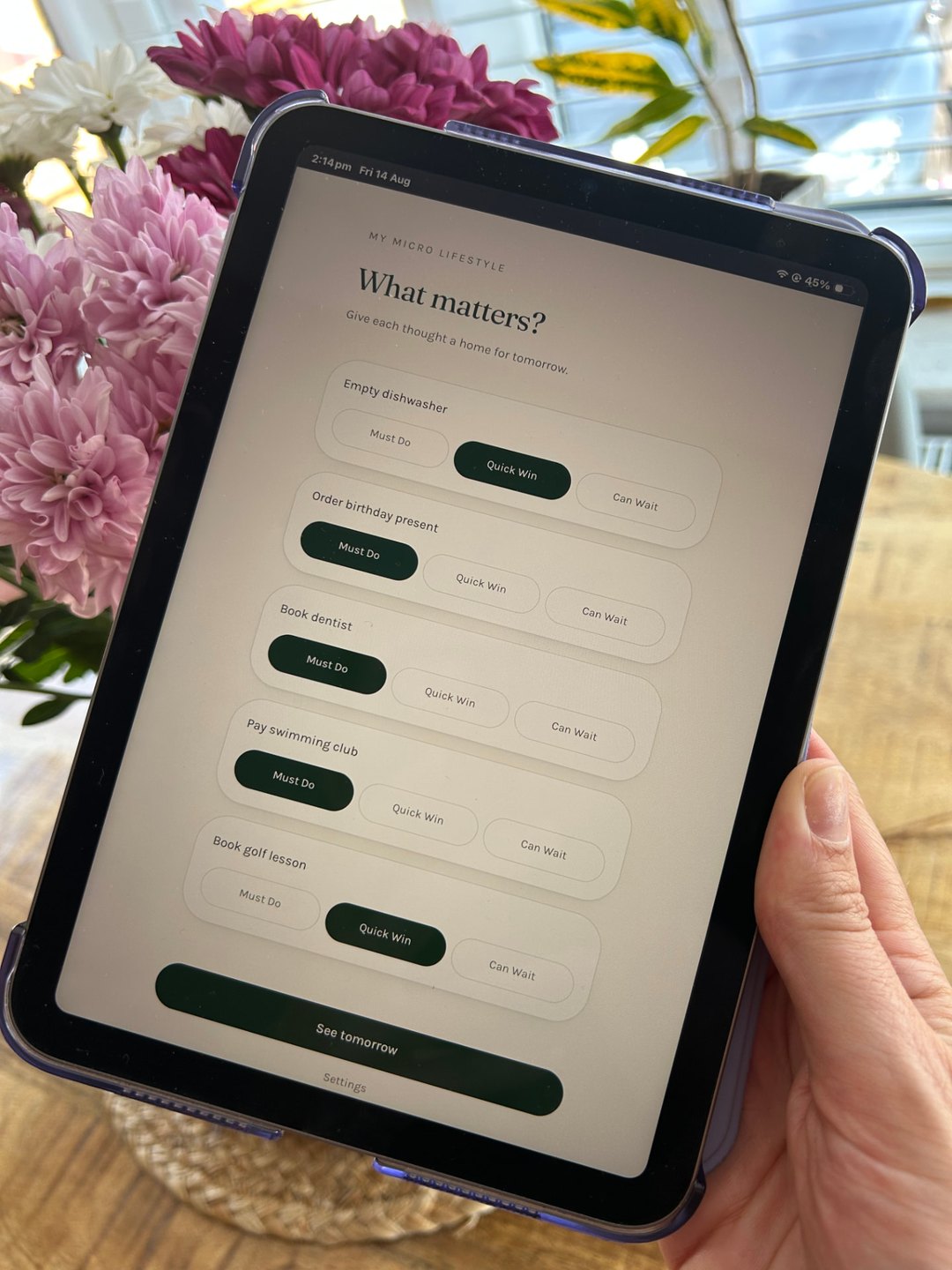
After trying various lists, notes and ways of organising everything, I realised I didn’t actually need another complicated system.
I needed somewhere to put everything that was in my head.
And then I needed help deciding what to do with it.
So I’ve ended up with a really simple two-part process.
First, dump everything
I start with a completely blank space and write down whatever is taking up room in my head.
No categories. No priorities. No trying to make the list look organised.
Just…
- Book dentist.
- Order birthday present.
- Reply to that message.
- Sort car insurance.
- Buy dog food.
- Look at holiday dates.
- Clean bathroom.
- That business idea I randomly thought of while making dinner.
It can be something I need to do, something I don’t want to forget or simply something my brain keeps bringing back up.
If I’m thinking about it, it goes down.
And I keep going until I get that lovely little moment of…
Right. Is that everything?
Usually followed thirty seconds later by one more thing.
Obviously.
Then, I work out what matters
This is the bit that changed brain dumping for me.
Because getting everything out of my head felt good.
But being left with a huge list of things to do?
Not quite as calming.
So instead of treating my brain dump as one giant to-do list, I go through each thing and make a decision about it.
I ask:
Then I sort things into three simple groups.
Must Do
These are the things that genuinely need my attention. Not everything I’d like to get done. The things that actually matter.
Quick Wins
The little jobs I can clear fairly easily. Sending a message. Ordering something. Booking an appointment. Those annoying little things that keep popping back into my head.
Can Wait
Everything that doesn’t need my attention right now.
And I’ve come to really appreciate this category.
Because Can Wait isn’t a dumping ground for things I’m avoiding.
It’s a decision.
I’m saying:
That distinction has made a massive difference for me.
This is exactly what the free Brain Dump Tiny App does — dump everything out, then decide what matters.
The goal isn’t an empty list
I think this is probably the most important part of the whole thing.
I’m not trying to get my brain dump down to zero.
I’m not trying to complete 25 tasks before I can consider the day productive.
And I’m definitely not trying to squeeze something useful into every spare minute I have.
The goal is simply to get the noise out of my head, decide what deserves my attention and give myself permission to leave the rest.
Because when I know the other things are safely somewhere else, I don’t have to keep mentally carrying them.
And that gives me more space to be where I actually am.
Why I built the Brain Dump Tiny App
I didn’t set out to build a productivity app.
I actually built this because I wanted it for myself.
I’d tried writing brain dumps in notebooks. I’d used my phone notes. I’d downloaded organisation apps and attempted to create systems I’d inevitably stop using a week later.
I didn’t want another planner.
I didn’t want something with 14 different sections I needed to keep updated.
And I definitely didn’t want another system that somehow became another thing on my list to manage.
I just wanted somewhere I could open when my head felt full, get everything out and then work out what actually mattered.
So… I built it.
Meet Brain Dump
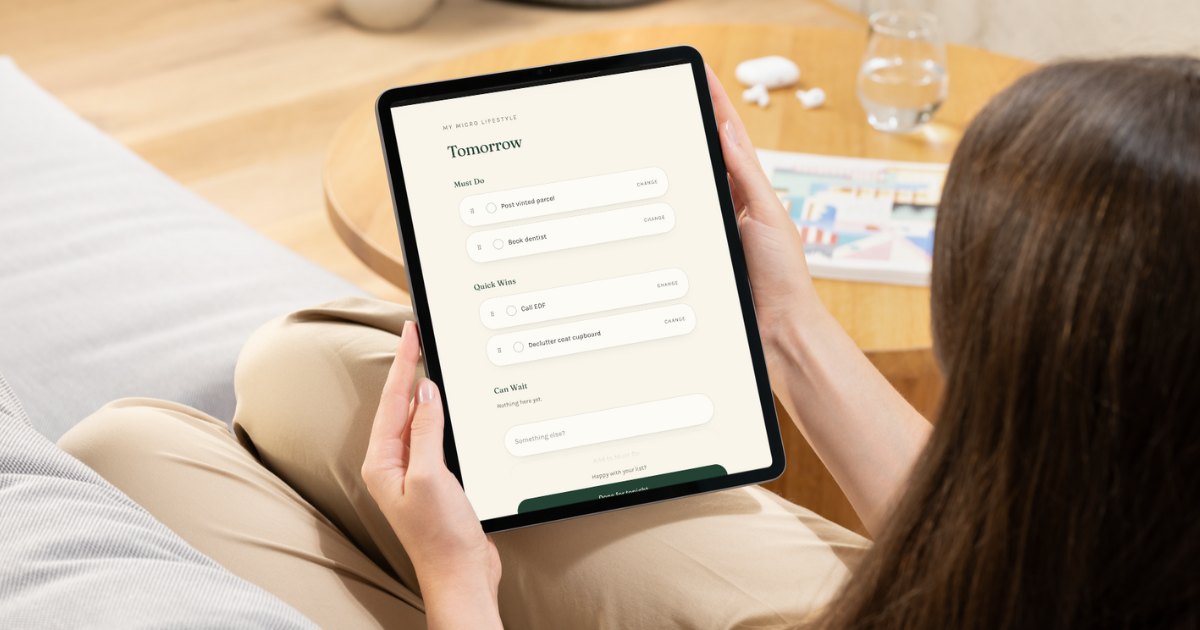
Brain Dump is a free Tiny App I created to do exactly what I’ve talked about in this article.
You open it.
You dump whatever is taking up space in your head.
Then, instead of being left staring at one enormous list, you move into What Matters.
From there, you sort each thought into:
- Must Do — the things that genuinely need your attention.
- Quick Wins — the little things you can get sorted fairly easily.
- Can Wait — everything you've acknowledged but don't need to carry right now.
That’s it.
No complicated productivity method to learn.
No beautifully organised planner you have to remember to maintain.
It’s intentionally small.
Why a Tiny App?
I’m becoming slightly obsessed with the idea of Tiny Apps.
Instead of one huge app trying to organise every area of your life, I like the idea of small tools that solve one specific everyday problem really well.
Brain Dump solves one:
Open it. Dump it. Decide what matters. Carry on with your day.
And Brain Dump is only the beginning.
I’m building My Micro Lifestyle around this idea of making small parts of everyday life feel a little simpler — so we can spend less time managing everything and more time actually living it.
If that sounds like something your brain could use too, you can try Brain Dump completely free.